




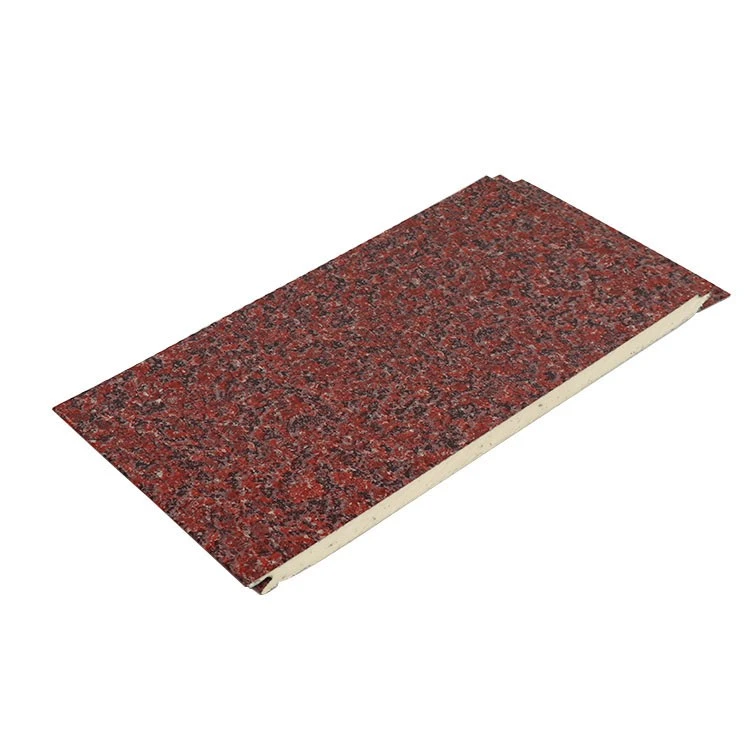

Exterior Metal Wall Cladding Sheets
High-Strength Insulation Material: Insulation is primarily provided by polyurethane, a polymer material mainly composed of isocyanates and polyols, with a hardness range between Shore A0 and Shore D90. Its performance lies between plastics and rubber, combining high elasticity and abrasion resistance. Therefore, exterior metal cladding panels possess extremely high-strength insulation performance.
Advantages of exterior metal wall cladding sheets from a Materials Science Perspective:

High-Strength Insulation Material
Insulation is primarily provided by polyurethane, a polymer material mainly composed of isocyanates and polyols, with a hardness range between Shore A0 and Shore D90. Its performance lies between plastics and rubber, combining high elasticity and abrasion resistance. Therefore, exterior metal cladding panels possess extremely high-strength insulation performance.

Extremely High Heat Resistance
The surface of the panels uses steel plates coated with an aluminum-zinc alloy, mainly composed of 55% aluminum, 43.4% zinc, and 1.6% silicon. A continuous melt coating process results in a uniquely smooth surface, allowing it to withstand environments up to 315 degrees Celsius. This is why this type of exterior wall panel is used in many tropical countries worldwide, in addition to its rapid installation characteristics.

Flame-retardant fireproof standards
According to Chinese standard GB8624, the corresponding standard for our material b1 in the European Union is EN13501. This means that the board is an internationally recognized fireproof board that is almost impossible to burn, which is of strategic significance for improving building safety.
Physical Properties and Technical Specifications
|
Item |
Specification |
|
Product Name |
exterior metal wall cladding sheets |
|
Product Thickness |
16mm / 20mm |
|
Standard Width |
383mm |
|
Thermal Conductivity |
Approx. 0.018 - 0.024 W/m.k |
|
Thermal Resistance |
Approx. 2.09 m²k/w |
|
Core Material Density |
Approx. 40 +/- 2 kg/m³ |
|
Unit Weight |
Approx. 3.5 - 3.8 kg/m² |
|
Compressive Strength |
Approx. 52.7 kPa |
|
Fire Rating |
B1 and B2 |
|
Insulation Temperature Difference |
Indoor/Outdoor Temperature Difference Up to 17 Degrees Celsius |
How is a Seamless Appearance Achieved? -Technical Analysis
The core of achieving a seamless appearance for exterior metal wall cladding sheets lies in concealed fastening technology. This is not only about visually eliminating gaps, but also a demonstration of the factory's technological prowess. Below, I will analyze the technical principles behind this achievement in detail.


1. Male and Female Interlocking Structure
The first step in achieving a seamless appearance is eliminating physical fasteners on the surface by machining the panel edges into specific male and female geometry. When installing the first panel, fasteners are driven onto concealed flanges on the panel edges. The second panel, installed subsequently, utilizes its female side groove to physically cover the fixing area of the first panel and tightly interlock with it.
2. Movable Hangers and Floating System
To maintain surface flatness over long spans, the thermal expansion and contraction characteristics of metal need to be addressed. The installation system no longer directly and rigidly fixes the panels to the purlins, but instead uses independent hangers for anchoring. One end of the hanger is fixed to the building substrate, and the other end interlocks with the panel's folded edge. This mechanism allows the panel to expand and contract freely longitudinally with temperature changes, preventing panel deformation caused by thermal stress.
3. Precision Bending and Edge Folding Technology
Using CNC machine tools for grooving and bending, that is, precisely cutting V-grooves on the back of the metal sheet before bending. This achieves an extremely small bending radius, giving the corners a sharp edge as if cut from a single piece. An internal edge folding process is also used, folding the metal sheet edges inward to eliminate any exposed edges.
4. Capillary Blocking Design and Isobaric Principle
In terms of physical sealing, the internal structure of the joint is not completely tight, but rather has a small cavity. Utilizing the isobaric principle from aerodynamics, the air pressure inside and outside the joint is kept balanced. Gravity and internal drainage channels guide moisture away, eliminating the need for a heavy external sealing strip, thus avoiding sealant contamination and visual discontinuity.
Special Considerations for Coastal Areas (Countries)
1. Beware of the Rain-Shielding Effect
In coastal countries and regions, the focus is often not on areas directly exposed to rain, but rather on areas not directly washed by rain. Why? Because rainwater washes away most corrosive salts, while areas not washed away by rain often undergo crystallization reactions, leading to severe electrolyte corrosion of the exterior metal wall cladding sheets. Increase the frequency of washing eaves and corners in your maintenance plan.
2. Chemical Compatibility of Cleaning Agents
While PVDF coatings are stable in coastal environments, long-term exposure to salt spray can cause them to become microporous. Using thinner, acetone, or abrasive cleaners can damage the molecular structure of the coating, causing it to quickly chalk.
3. Prevent Electrochemical Corrosion
In the highly conductive air of coastal areas, metals with different potentials are highly susceptible to corrosion upon contact. Therefore, we recommend that all connections and fasteners be made of 316 stainless steel or specially coated parts with equivalent corrosion resistance, and that insulating gaskets or washers be used between them and the wall panels.
4.Optimal Cleaning Time In coastal areas and countries, it is also important to pay attention to the cleaning time. Try to clean in the early morning, evening, or on cloudy days, and avoid cleaning in the hot sun. This is because rapid evaporation of water will leave hard-to-remove dried agent or water stains on the metal surface, affecting the wall finish.
Standardized Chinese manufacturer of exterior metal wall cladding sheets
|
Certificates and Certifications |
Nature and Coverage of Certifications |
International Recognition |
|
ISO 9001:2015 |
Quality Management System Certification |
Globally recognized management standard |
|
ISO 14001:2015 |
Environmental Management System Certification |
Proves green compliance in production processes |
|
ISO 45001:2018 |
Occupational Health and Safety Management System Certification |
Protects employee rights and ensures workplace safety |
|
CE Certificate |
EU mandatory safety accreditation |
proof of market access in Europe |
|
TUV Test Report |
Independent third-party testing by the European Union's Technical Inspection Association |
providing high credibility for physical performance |
|
RoHS Compliance |
Restriction of Hazardous Substances Directive |
ensuring products are lead-free, mercury-free, and meet environmental and health requirements |
|
Green Supply Chain Certificate |
Full-chain sustainability assessment |
ratings contributing to environmentally friendly building practices |
Hot Tags: exterior metal wall cladding sheets, China exterior metal wall cladding sheets manufactures, suppliers, factory

